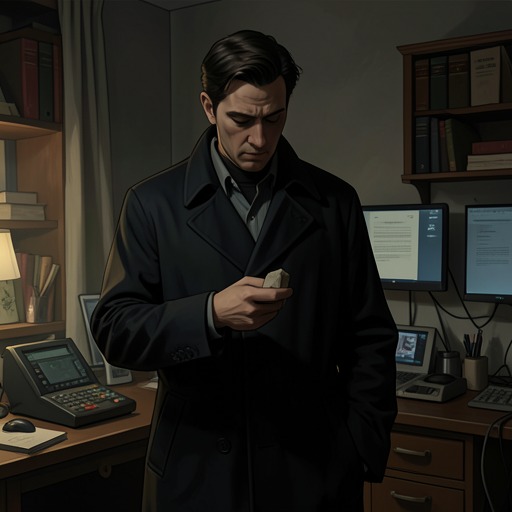
Leamas’s staged decline and assault on the grocer
The Spy Who Came in from the ColdAlec Leamas’s staged decline and assault on the grocer convert an apparent professional and personal collapse into a conspicuous public incident. After being put aside at the Circus, Leamas seems to waste away within months; he then disappears amid suspicion about missing funds, before a deliberately unsuccessful request for grocery credit precipitates an assault. The performance carries him from the closed world of the Service into prison, where the practical consequences of his act are joined by the nightly reality of confinement.
Professional Decline
The new men at the Circus are told that Leamas belongs to the old school, associated with experience rather than a degree. That shorthand does not fully describe him: he is bilingual in German and English, speaks admirable Dutch, and dislikes cricket. With only a few months left on his contract, he is assigned to Banking, a section responsible for overseas payments, financing agents, and operations. Its work is highly secret but often treated as a place where officers are put aside before leaving the Service.
Leamas’s decline is described as astonishingly swift. Within a few months, colleagues see him change from a man honourably sidelined into a resentful, drunken wreck. His deterioration is not merely a matter of appearance: he borrows small sums from secretaries without returning them, arrives late or leaves early, and becomes neglectful and malicious. Colleagues initially respond with indulgence, but his behavior eventually isolates him. The rapidity of the change makes the appearance of collapse itself striking, as if the active agent has lost the will that once gave his work its direction.
He seems not to care that he has been put on the shelf. He takes less care of his appearance and surroundings, eats in the canteen used by junior staff, and is rumored to be drinking. The account presents him as a solitary, like a swimmer barred from the water or an actor banished from the stage: someone whose identity has been shaped by action and who is now conspicuously deprived of it. This visible idleness supplies the impression of a man with nothing left to protect or pursue.
The reasons for Leamas’s earlier professional failure remain uncertain to his colleagues. Some believe he made a mistake in Berlin and that this led to the destruction of his network, but no one knows for sure. They agree, however, that the Service has treated him unusually harshly. Their whispered description of him as a failure who has let himself go turns his decline into office gossip, while the uncertainty surrounding Berlin leaves the actual cause out of reach.
Disappearance and Suspicion
One day Leamas vanishes without saying goodbye, apparently not even to Control. The Service’s conventions make elaborate farewells unlikely, but his departure is abrupt even by those standards and seems to occur before his contract is due to end. Elsie in Accounts supplies scraps of information: he has taken the balance of his pay in cash, his gratuity is expected at the turn of the month, and Personnel has forwarded his National Insurance card. Personnel has an address for him but will not disclose it.
Rumor then connects the departure to irregularities in Banking Section’s accounts. A substantial sum is said to have gone missing and nearly all of it to have been recovered; another detail of the gossip is that a lien has been placed on Leamas’s pension. The allegations remain contested. Some colleagues doubt that he would steal from the Circus in such an inept way, while others point to his drinking, the expense of maintaining a separate household, the difference between domestic pay and foreign allowances, and his access to large sums of covert money. The narrative establishes suspicion, not a confirmed account of what happened to the funds.
The threat of lasting exclusion gives the rumor its weight. If Leamas has taken money, colleagues believe, he will be finished with the Service: Resettlement will not help him, and Personnel will not give him a useful reference. Peculation is described as an offense the department never forgets. Thus his disappearance appears to have both an immediate practical dimension—cash, pension, address—and a possible institutional aftermath in which the organization could deny him a future beyond its own walls.
The Credit Request and Assault
The next clear step comes on a Saturday morning, when Leamas asks the local grocer for credit. He orders half a dozen items costing no more than a pound and, once they have been wrapped and put in the carrier bag, tells the grocer to send him the account. The request is made without much artistry and is not calculated to succeed. Its small scale and ordinary setting contrast with the elaborate secrecy of the work Leamas has left behind.
The grocer answers that he requires a banker’s reference before granting credit. Leamas loses his temper, objecting that many customers have never been inside a bank. When the grocer says that he does not know or like Leamas and orders him out, he tries to take back the parcel. Leamas is already holding it. Accounts of the immediate physical exchange differ: some say the grocer pushed him, others say he did not. The shared account is that Leamas struck the grocer twice, with movements made while his right hand still held the shopping bag. The grocer fell and lay still; the later court account, not challenged by the defence, records a fractured cheekbone and a dislocated jaw. The incident receives adequate, though not extensive, coverage in the daily press.
Imprisonment and Narrative Function
At night in prison, Leamas listens to the other prisoners: a boy sobs, an older prisoner sings “On Ilkley Moor bar t’ at” and keeps time on a food tin, a warder shouts at him after each verse, and an Irish prisoner sings songs about the IRA. Leamas tries to exercise during the day in the hope of sleeping, but the nights remain difficult. The account makes the loss of freedom a continuing consequence of the grocer incident, not a momentary aftermath: in the cell, there is no distraction that can make the fact of imprisonment recede.
His thoughts move briefly to Liz, then turn away from her; he is not accustomed to living on dreams. That small recollection links the public performance of his decline to a more private separation, without making the assault a scene of reconciliation or rescue. Structurally, the episode joins an apparently spontaneous breakdown to an action whose circumstances are conspicuously ill-judged. The contrast between the meanness of the credit dispute and the seriousness of its consequence gives the staged decline its force: Leamas’s public reputation as a ruined man is carried forward by an arrest and a prison sentence, while the evidence leaves the precise explanation of his earlier financial rumors unresolved.